
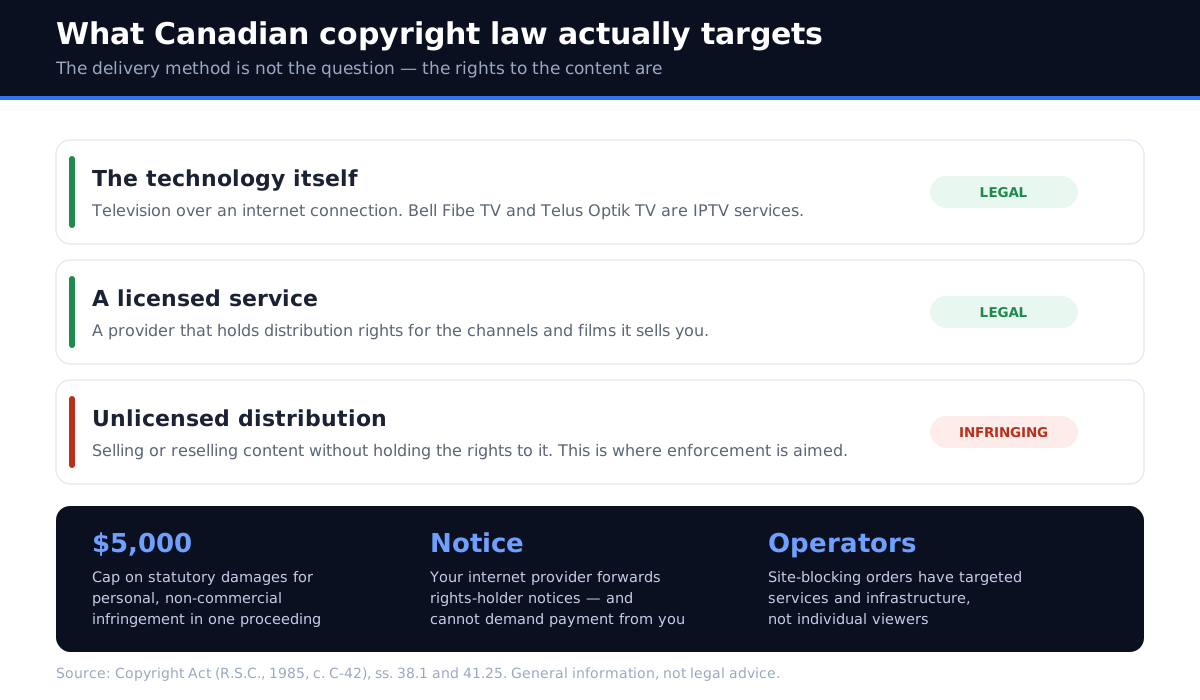
Is IPTV legal in Canada? Short answer: yes. The technology that delivers television over an internet connection is the same technology Bell Fibe TV and Telus Optik TV run on. What decides legality is not how the signal travels, but whether the service distributing it holds the rights to the content it sells.
That distinction matters, because the question people usually mean is narrower: am I going to get in trouble for subscribing to one of these services? This guide answers that properly, with reference to what Canadian law actually says and what Canadian courts have actually done.
This is general information, not legal advice. For advice about your own situation, speak to a Canadian lawyer.
Is IPTV Legal in Canada? The Technology Is, the Content Decides
IPTV stands for Internet Protocol Television. It means television delivered over an internet connection instead of a coaxial cable or a satellite dish. Nothing about that is unlawful, and Canada’s largest telecom companies use it: Bell Fibe TV and Telus Optik TV are IPTV services.
The legal question attaches to the content. Every channel and every film is owned by someone, and the right to broadcast it in Canada is sold, usually exclusively and usually by territory. A service that has paid for those rights is distributing content it is entitled to distribute. A service offering twenty thousand channels for nineteen dollars a month almost certainly has not, because the licensing alone would cost many times that.
So the real question behind “is IPTV legal in Canada” is a narrower one: does this particular provider hold distribution rights for what it is selling me?
Is IPTV Legal in Canada Under the Copyright Act?
The governing statute is the Copyright Act, published by the Department of Justice. A few parts of it matter here.
Infringement is usually a civil matter, not a criminal one
Most copyright infringement in Canada is dealt with through civil lawsuits brought by rights holders, not criminal prosecution. The Copyright Act does contain criminal provisions, but they are aimed at commercial-scale activity: selling, distributing, or trading in infringing copies for commercial gain. Someone operating or reselling an unlicensed IPTV service is exposed to that. Someone watching at home generally is not in the same category.
Statutory damages are capped for non-commercial infringement
Canada treats personal, non-commercial infringement differently from commercial infringement. Statutory damages for non-commercial infringement are capped at a total of $5,000 for all works involved in a single proceeding, rather than per work. This is a deliberate policy choice by Parliament and it is why Canada has not seen the mass lawsuits against individual viewers that happened in the United States.
Notice and notice, not notice and takedown
Canada operates a “notice and notice” regime. A rights holder who identifies an IP address associated with infringement can send a notice to the internet provider, and the provider is required to forward it to the subscriber. The provider does not have to disconnect you, and it does not hand over your identity without a court order. Since 2018, those notices are also prohibited from containing settlement demands or payment requests.
If you receive a forwarded notice from Rogers, Bell or your own ISP, that is this system working as designed. It is not a lawsuit.
What Canadian Courts Have Done
Court decisions answer “is IPTV legal in Canada” far better than opinion does. Enforcement here has concentrated on services and infrastructure, not subscribers.
The landmark case is Bell Media v. GoldTV, decided by the Federal Court of Canada. In 2019 the Federal Court issued Canada’s first site-blocking order, requiring major Canadian internet providers to block access to an unlicensed IPTV service. The Federal Court of Appeal upheld that order in 2021, establishing that site blocking is available as a remedy in Canadian copyright cases.
Courts have since gone further, granting dynamic blocking orders that allow rights holders to update the list of blocked servers during live sports broadcasts, as streams move to evade blocking.
The practical consequence for a subscriber is not a legal one. It is that your service can stop working, without warning and without refund, because the servers it depends on have been blocked or taken down. People who paid for a twelve-month subscription and lost it in month three did not get prosecuted. They lost their money.
So What Is the Actual Risk to a Subscriber?
Asking “is IPTV legal in Canada” usually really means asking what could happen to you personally. Being realistic about that is more useful than scaring you or reassuring you.
- Prosecution of individual viewers is not something Canada does. There is no pattern of Canadian subscribers being criminally charged for watching an unlicensed stream at home.
- A forwarded infringement notice is possible if your activity is identified. It is a letter, not a charge.
- Service interruption is the real and common risk. Blocking orders, server seizures and provider disappearances happen regularly, and prepaid subscriptions are rarely refunded.
- Payment and data risk is underrated. Services operating outside the law tend to take payment methods with no recourse, and handle your personal information accordingly.
- Operating or reselling is a different matter entirely. If you are selling access rather than buying it, you are in the category Canadian enforcement is actually aimed at.
How to Tell Whether a Provider Is Operating Legitimately
There is no public registry you can check, so you have to read the signals. These are the ones that matter.
Signs a service is operating above board
- It states clearly what rights it holds and which content it is licensed to distribute
- Its channel lineup is plausible, in the hundreds rather than tens of thousands
- Its pricing bears some relationship to what content licensing costs
- It has a registered business identity, a real address and a published refund policy
- It accepts payment methods that carry buyer protection
Signs to treat as warnings
- Twenty thousand channels and every pay-per-view event for the price of a sandwich
- Every premium sports package in the world included, with no mention of rights
- Payment only by cryptocurrency or irreversible transfer
- No company name, no address, no way to contact anyone
- Sales conducted entirely through a messaging app
- Language about “bypassing”, “unlocking” or “no restrictions”
The cost test is the most reliable single indicator. Broadcast rights are the single largest expense in television. When a price makes those rights arithmetically impossible, that tells you what you need to know.
The Legal Alternatives in Canada
If what you want is to stop paying $120 a month to a cable company, you have licensed options that do not involve this question at all.
- Bell Fibe TV and Telus Optik TV are licensed IPTV services from Canadian carriers
- Crave, Netflix, Prime Video, Disney+ cover most scripted and film content
- DAZN, TSN+ and Sportsnet+ carry most live sport, sold directly
- Free over-the-air television still exists. A $40 antenna gets you CBC, CTV, Global and more in most Canadian cities, legally and permanently free
- Pluto TV and Tubi offer licensed free ad-supported channels
A combination of two or three of these usually costs less than cable and removes the legal question entirely.
Does a VPN Make Unlicensed IPTV Legal?
No. A VPN does not change the answer to “is IPTV legal in Canada” for the service you are using. It encrypts your connection and hides your IP address from your internet provider. It changes who can observe what you are doing. It does not change whether what you are doing infringes copyright.
Using a VPN is itself perfectly legal in Canada and has legitimate privacy uses. But anyone presenting a VPN as the thing that makes an unlicensed service lawful is telling you something false, and the fact that they need to say it tells you what kind of service it is.
Is IPTV Legal in Canada? The Honest Summary
Is IPTV legal in Canada? As a technology, entirely, and it is used by the country’s biggest broadcasters. Whether a specific service is lawful depends on whether it holds the rights to what it distributes, and a price that is too good to be true is usually the clearest evidence that it does not.
Canadian enforcement is directed at operators and resellers rather than individual viewers, and statutory damages for personal non-commercial infringement are capped at $5,000. The realistic risk to a subscriber is not a courtroom. It is paying for twelve months and losing access in month three.
If you are comparing services, read our guide to IPTV plans and pricing in Canada and our installation guide for setting up on your devices.
Frequently Asked Questions
Is IPTV illegal in Canada?
No. The technology is legal and is used by Bell and Telus. What can be unlawful is a service distributing content it does not hold the rights to.
Can I be charged for watching IPTV in Canada?
Criminal prosecution of individual home viewers is not a pattern in Canada. The criminal provisions of the Copyright Act are aimed at commercial-scale distribution. Operating or reselling a service is a very different position from subscribing to one.
What happens if I get a copyright notice from my internet provider?
Under Canada’s notice and notice system, your provider is required to forward notices from rights holders. It is not a lawsuit, your provider does not have to disconnect you, and since 2018 those notices cannot legally demand payment from you.
How much can I be fined for copyright infringement in Canada?
Statutory damages for personal, non-commercial infringement are capped at a total of $5,000 for all works in a single proceeding. Commercial infringement carries substantially higher exposure.
Why do some IPTV services suddenly stop working?
Canadian courts have issued site-blocking orders requiring internet providers to block unlicensed services, including dynamic orders that update during live sports. Services also lose servers to seizures and shutdowns. Prepaid subscriptions are rarely refunded when this happens.
Does using a VPN make IPTV legal?
No. A VPN affects privacy, not legality. It does not change whether the content you are accessing is licensed.
How can I tell if an IPTV provider is legitimate?
Look at the arithmetic. Check whether it names the rights it holds, whether the channel count and price are plausible against real licensing costs, whether there is a registered business identity and refund policy, and whether it accepts payment methods with buyer protection.